Term vs whole life insurance: what the price gap actually buys
Start with the number that drives every other part of this decision. For a healthy 35-year-old non-smoker buying $500,000 of coverage:
| Monthly premium | |
|---|---|
| 20-year level term | about $35 |
| Whole life | about $450–700 |
Same death benefit. Roughly ten times the price. Any argument for whole life has to be worth that multiple, because the alternative use of the difference - about $5,000 a year - is not nothing.
What each product actually is
Term life covers a fixed period: 10, 20 or 30 years. Level premium, level death benefit, no cash value. If you die during the term, it pays. If you outlive it, it ends and pays nothing. It is pure insurance, priced as such.
Whole life covers you until death whenever it comes, with a premium that is guaranteed never to rise and a cash value that builds inside the policy. Part of each premium buys insurance; part goes into a reserve you can borrow against or take by surrendering the policy. Mutual insurers also pay non-guaranteed dividends, which can buy additional paid-up coverage.
Universal life sits between them: permanent coverage with flexible premiums, and - in the guaranteed-death-benefit form - a common middle option when a permanent need exists but whole life pricing does not fit.
Where the extra premium goes
Three places, and only one of them is coverage.
The cost of insuring you at 80. Term at 35 insures a 35-to-55-year-old, and the probability of dying in that window is low. Whole life insures you for the year you die, whenever that is, and the premium is levelled across your whole life to make that affordable. Most of the difference is this, and it is honest pricing rather than a markup.
The cash value reserve. Money you get back, eventually. The catch is the shape of the curve: first-year commissions and expenses mean cash value in the early years is typically far below premiums paid - often near zero in year one - and policies commonly take ten to fifteen years to break even against what you put in. Whole life rewards patience and punishes second thoughts.
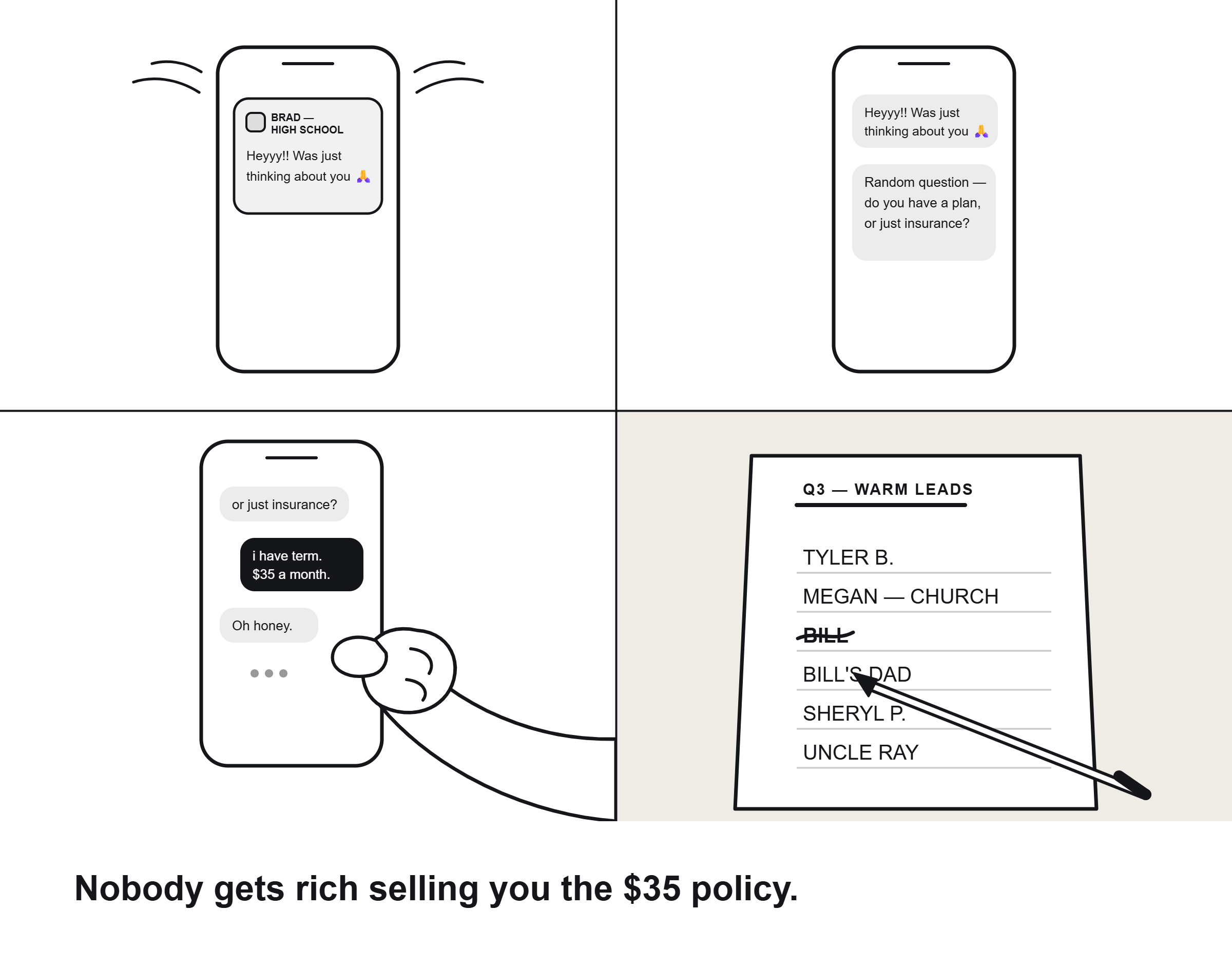
Distribution. Whole life carries much higher first-year commissions than term, which is one reason it is recommended more often than the arithmetic supports.
The persistency problem
Whole life only makes sense if you keep it. Industry data puts the annual lapse rate on whole life at roughly 3%. Compounded, that means about a quarter of policies are gone within ten years - surrendered or lapsed, usually after the years when the cash value is worth least relative to the premiums paid.
A buyer who lapses in year six has paid whole life prices for term life coverage and received a fraction back. Before signing up for a permanent premium, be honest about whether it survives a job loss, a move or a new baby.
The tax picture - the real advantage
This is where whole life has a genuine, structural edge, so it is worth being precise:
- The death benefit is generally income-tax-free to the beneficiary. So is term's. No difference.
- Cash value grows tax-deferred. No annual 1099, no drag from taxable interest or dividends.
- Policy loans are generally not taxable while the policy stays in force, which is the basis of most "be your own bank" pitches. If the policy lapses with a loan outstanding, though, the gain becomes taxable in a year when you have no money to pay it.
- Surrendering pays out tax-free up to your basis - total premiums paid - with anything above that taxed as ordinary income.
- Overfund it and it becomes a modified endowment contract. Pay in faster than the seven-pay test allows and the policy becomes an MEC: loans and withdrawals become taxable to the extent of gain first, with a 10% penalty before age 59½. The death benefit stays tax-free, but the flexibility that justified the design is gone.
One thing whole life does not do by itself: keep the payout out of your estate. If you own the policy, the proceeds count in your estate. That is what irrevocable life insurance trusts exist for - see the guide to life insurance and taxes.
"Buy term and invest the difference"
The standard advice, and mathematically strong: $5,000 a year invested for 30 years at a market return finishes well ahead of the cash value in most whole life illustrations, and you keep the liquidity.
The honest caveat is behavioral. The strategy only works if the difference is actually invested, every year, and left alone. A forced premium that you will pay because a bill arrives is worth more than an investment plan you abandon in year three. That is a real argument - it is just an argument about you, not about the product, and it should be tested against a payroll-deducted 401(k) or an automatic IRA transfer before you conclude that an insurance policy is the only thing that will make you save.
When whole life genuinely fits
The permanent-need list is short and specific:
- A dependent who will never be financially independent. A child with a disability needs support after you are gone at any age, not for the next 20 years. This is the strongest case there is, usually paired with a special needs trust.
- Estate liquidity for an illiquid estate. A family farm, a closely held business, real estate holdings - heirs may owe tax and costs but hold nothing they can easily sell. A permanent policy provides cash at exactly the moment it is needed.
- Business continuity. Buy-sell agreements and key-person coverage need to be in force whenever the event happens, not for a fixed 20 years.
- Final expenses on a modest scale. Small whole life policies aimed at funeral costs are a legitimate, if expensive, product - and the reason average whole life payouts are so much smaller than term ones.
- High earners who have maxed everything else. After the 401(k), IRA, HSA and taxable brokerage, a tax-deferred insurance wrapper starts to look reasonable. Not before.
If none of these describes you, the temporary need - mortgage, income replacement, kids to adulthood - is exactly what term insurance is built for.
How to work through it
- Size the need. The calculator runs the DIME method and shows the gap. See how much life insurance you need.
- Buy that whole number in term, first. Being under-covered in cheap insurance is the expensive mistake; owning $150,000 of whole life instead of $750,000 of term is the version of it people regret at claim time.
- Ask whether a permanent need exists from the list above. If it does, size that separately - it is usually far smaller than the income-replacement number.
- Match term length to your longest obligation, then check what it costs by age.
- If you are quoted whole life, ask for the guaranteed column of the illustration, not the projected one, and ask what the surrender value is in years 5 and 10.
This is general information, not financial, tax or legal advice. Illustrations are not guarantees, and dividend projections are not promises - read the guaranteed figures and consider a fee-only planner who is not paid by the sale.